2026 Travel Trends: Saudi Travellers Prove Resilient as Flexibility, Convenience and AI Reshape How They Book

Almosafer Travel & Tourism Co., Saudi Arabia’s leading travel company, has revealed the latest travel trends for Saudi travellers across the first seven months of 2026. Based on proprietary data from Almosafer’s consumer travel channels between 1 January and 31 July 2026, the report compares year-on-year performance across travel products, uncovering shifts in destination preferences, booking behaviours, payment choices, accommodation, and traveller segments as the Kingdom’s tourism offering matures under Vision 2030.
Saudi travel demand proved resilient amid regional volatility. Faced with shifting geopolitical dynamics across parts of the wider region, Saudi travellers did not travel less – they shifted their travel patterns, and the most significant shift was inward.
The Kingdom Became the Destination
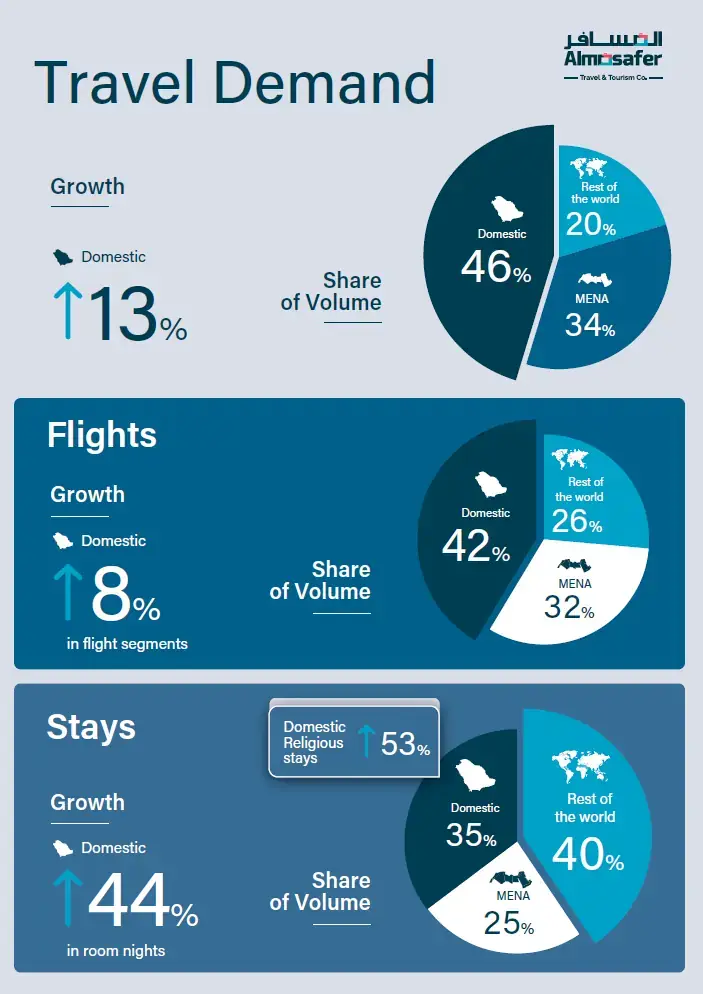
Domestic travel now accounts for 46% of all bookings, with bookings up 13% year-on-year and domestic room nights up 44%.
Religious travel supplies the scale. As domestic demand grew this year, much of it landed in Makkah and Madinah, where room nights rose 53%. Expanded hotel supply and improved accessibility to the holy cities meant the Kingdom could absorb it, giving travellers more choice of where to stay and making the journey easier to plan and book.
Domestic leisure is driving the momentum as growth came with a sharp uplift in value: the average order value of a domestic leisure booking roughly doubled year-on-year – a market where premium supply is gaining visibility. The Red Sea leads it, with room nights up 4,000+% and the highest average order value of any destination Saudi travellers book globally, ahead of both Paris and London. Alongside it, the Aseer region, AlUla, Taif, Jizan and new properties in King Abdullah Economic City are all drawing growing interest – evidence of a domestic market with real depth rather than a single flagship. The everyday base also held firm, with Riyadh, Jeddah and AlKhobar remaining the destinations Saudi travellers return to most.
A Wider Map Abroad
As route availability and regional conditions shifted through the year, Saudi travellers ventured well beyond the established city breaks of Cairo, Doha, Dubai and Manama and into a wider MENA set – led by Egypt’s North Coast and Red Sea Coast, and by Tangier and Marrakesh in Morocco. Coastal resorts, cultural destinations and North African cities that were not on most Saudi itineraries a year ago were trending choices in 2026.
Beyond the region, Istanbul, London, Paris and Phuket remain popular, while Saudi travellers pushed into a wider set of cities – Moscow, Athens, Madrid and Shanghai among the most trending. As new travel corridors open from the Kingdom, Saudi travellers are exploring more of the world than ever before, choosing destinations well beyond the routes they have travelled for years.
Flight Trends
Low-cost carriers hold 60% of flight segments, with domestic low-cost carriers offering a network dense and affordable enough to make travel a casual decision rather than a planned event. National carriers, meanwhile, are gaining ground across the whole network rather than only at home, lifting their share of total flight segments by 8 percentage points to 57%, as expanded route networks and added international capacity for destinations such as Malaga, Prague, Munich or Budapest put more Saudi carriers on international routes. That expansion shows up in the numbers: 33% of all international segments were flown on a Saudi carrier, evidence that more Saudi journeys now begin and end on a national airline rather than a foreign one.
Stay Trends
Saudi travellers continue to show a strong preference for premium accommodation, with four- and five-star properties holding 74% of room nights. That preference extends to the very top of the market: stays at the highest tier of average daily rates now make up 13% of all bookings, as more Saudi travellers trade up to the experience, rather than treating luxury as an occasional splurge.
At the same time, the definition of a good stay is widening. Alternative accommodation, including serviced apartments and holiday homes, grew 21% in room nights – Saudi travellers are not trading down so much as broadening what they are willing to book.
67% of all stay bookings were made within a week of travel – a trip decided and taken inside the same seven days. Abroad, families are splitting the decision. The hotel gets locked in early, with the average booking window for international family stays extending to 19 days, up 5% year-on-year. The flight is held back: average lead time on international flight bookings fell to 17 days, from 19 days in 2025, as travellers commit to the destination well ahead of time but wait closer to departure to confirm the flight itself. Saudis are travelling spontaneously at home and in two stages abroad, against an overall average booking window of 11 days across the platform.
The Connected Trip
Interest in destination-based experiences accelerated sharply. Activity bookings grew 464%, overwhelmingly within the Kingdom – Riyadh and Jeddah leading on volume, up 2,061% and 664%, alongside ever-popular Umrah-linked experiences, where Makkah rose 1,193%. The mix reflects how much wider the Kingdom’s offering has become: cultural and religious experiences, live entertainment and events, beach and resort access, and the theme parks now frequented in Qiddiya City, with Six Flags Qiddiya City and the Aquarabia Qiddiya City, are giving Saudi travellers a full itinerary to build around rather than a single day out.
Travellers are also increasingly joining the pieces together, with connected bookings linking a flight or stay to an activity or transfer up 368% – clear evidence that travel is now planned as a complete experience, not just a flight or a stay.
Protected, Convenient, and Paid for Differently
Safeguarding the trip has become part of how Saudi travellers book. Protection products grew 154% in customer adoption and 165% in purchases, now accounting for 48% of products booked alongside flights or stays, with baggage recovery up 474%, trip insurance up 132%, and cancellation freedom cover up 21%. Convenience follows the same logic: over 20% of all bookings include a convenience product, and convenience products now account for 40% of all product purchases booked alongside flights or stays, as travellers pay upfront for a smoother journey rather than at the point of travel. In a year of regional uncertainty, protection and convenience haven’t just grown as categories – they’ve become the terms on which Saudi travellers commit to travel.
Payment habits evolved in step: easy financing, including Buy Now Pay Later, reached 29% of all bookings, increasingly used for larger trips rather than smaller ones, while Apple Pay reached 44% of all payments. Flexibility has become a condition of the booking rather than a feature.
Travellers are also building the trip on their own terms. Round trips assembled from two separate tickets, matched to preferred timings and airlines, now make up 30% of all round-trip bookings, with travellers pairing carriers, cabins and departure times rather than accepting a single fare – treating the outbound and return as two independent decisions within one booking.
Digital and AI
The Almosafer app strengthened its position as the primary booking channel, at 77% of all bookings, up 7 percentage points. Retail remains a meaningful part of the mix at 6% of bookings and an average booking value roughly three times the digital average – a reminder that Saudi travellers still turn to human expertise and travel advisory for their most considered and highest-value trips.
AI assistance is becoming a popular choice for a more personalised search experience. Almosafer’s native AI filters, which let travellers narrow accommodation options in their own words rather than by clicking through fixed criteria, were used by 21% of travellers offered the feature. Almosafer’s integrations with ChatGPT and Claude are extending discovery beyond the app itself, letting travellers begin planning wherever they are already asking questions and arrive with intent already formed – the same conversational commerce behaviour that made WhatsApp a booking channel, now applied to how Saudis search.
Muzzammil Ahussain, Chief Executive Officer at Almosafer Travel & Tourism Co., said: ‘What this year showed us is the resilience of the Saudi traveller. Despite the geopolitical challenges across parts of the wider region, travel continued – differently, not less. Saudis chose the Kingdom in record numbers and at the top of the market, on the Red Sea, in AlUla, and for religious journeys in Makkah and Madinah, whilst exploring other parts of the Kingdom for leisure trips. That is Vision 2030 showing up in real booking behaviour. Internationally, they explored far beyond traditional routes, and their planning evolved with it, from bespoke itineraries and protection booked up front, to AI shaping how they search. At Almosafer, our role is to stay ahead of this evolution – making the Kingdom as seamless to book as any global destination while delivering the convenience and flexibility our travellers expect at every step.’
As Saudi travellers continue to explore the Kingdom and the world with equal confidence, Almosafer remains committed to connecting them to Saudi Arabia’s expanding tourism offerings and destinations beyond it, with the flexibility, protection, and digitally enabled experiences that define how they travel today.